
SEON Survey: 68% of Americans Use AI Agents Weekly, but Half Won't Let Them Pay
Over the past few weeks, we have written about AI agents that ask before they buy, such as Meta Muse in Singapore. A new survey shows why that step matters: people are used to handing tasks to agents, but they are not yet ready to hand over their wallet.
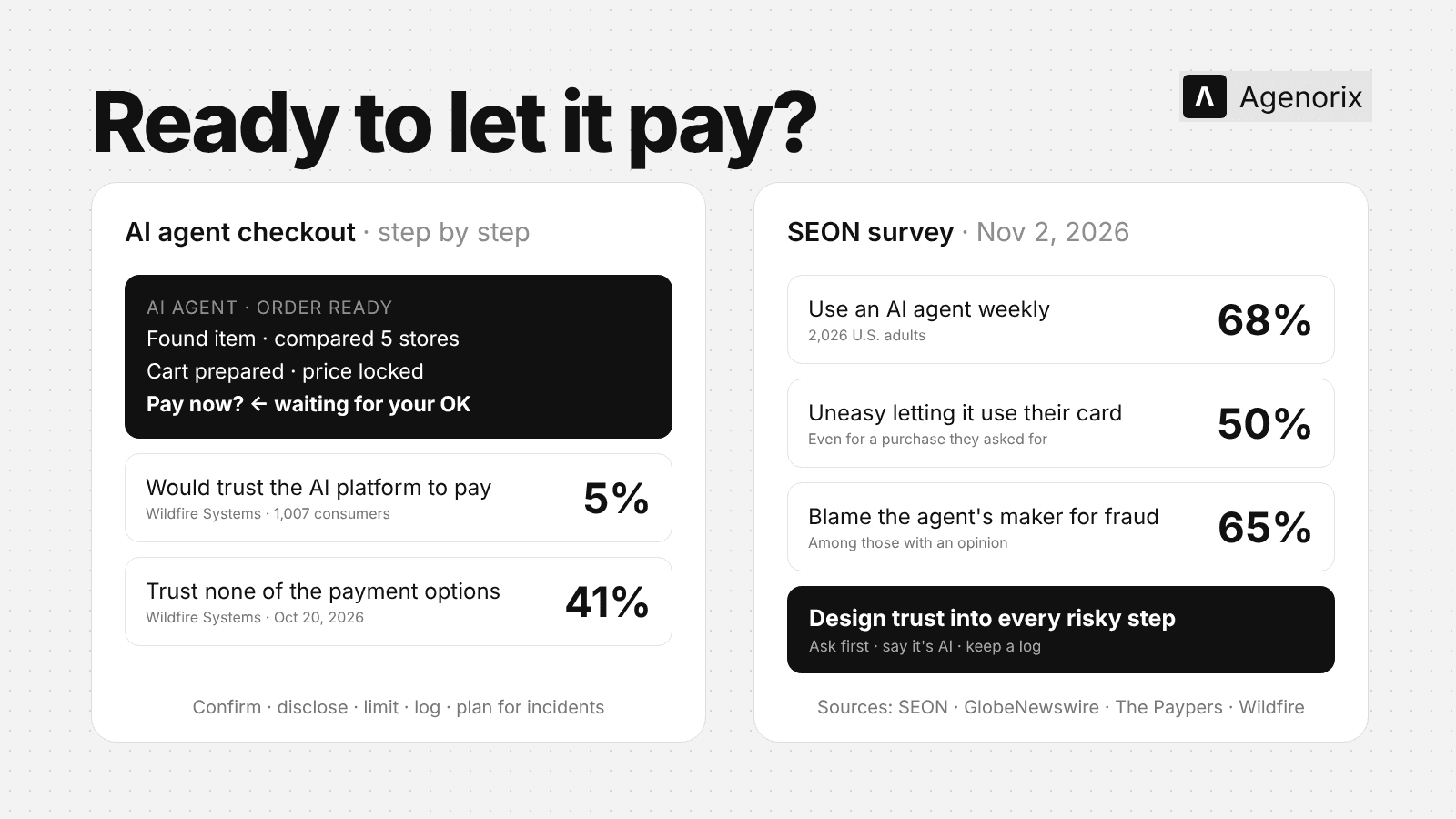
On November 2, 2026, fraud prevention company SEON published a survey of 2,026 U.S. adults. 68% use an AI agent at least weekly for personal tasks, yet 50% are uncomfortable letting an agent use their credit card, even for a purchase they asked for. The gap between using and trusting is now the biggest bottleneck for agentic commerce.
Heavy use, but little trust once money is involved
The survey was conducted online from October 2 to 6, 2026, with a margin of error of about 3 percentage points. These figures come from SEON, a company that sells fraud prevention software, so you should read them as a trend signal rather than an absolute number.
Frequent use: 68% of adults use an AI agent at least once a week.
Payment hesitation: 50% are uncomfortable letting an agent use their credit card, and nearly a third (32%) would not share any information with an agent at all.
Hard to tell real from fake: 43% are not confident they can judge whether an agent's request is legitimate, and 39% do not trust agents to recognize risky situations on their behalf.
A generational split: discomfort is highest among Baby Boomers (65%), followed by Gen X (52%), Gen Z (47%) and lowest among Millennials (34%).
When something goes wrong, users blame the agent's maker
The most telling question was who is responsible if an agent makes a fraudulent transaction. Among respondents with an opinion, 65% said the company behind the agent.
The agent's maker: 65%, many times more than any other party.
The users themselves: 14%.
The merchant: 11%, and the bank or card issuer: 10%.
The biggest worries: an attacker taking over the agent or the user's accounts, and an agent exposing personal or financial data without permission, each chosen by 20% of respondents.
A separate Wildfire Systems survey of 1,007 U.S. consumers, published on October 20, 2026, points the same way. Only 5% would trust the AI platform itself to process an agent's payment, 41% trust none of the options offered, and banks lead with 17%.
The Agenorix view: trust has to be designed into every step
Both surveys show that people are not against AI agents; they simply have not seen enough reason to trust agents at the risky steps. When we build AI chatbots and AI agents for our clients, we treat trust as part of the design, not something added later.
Ask for confirmation at key steps. An agent can search, compare and prepare an order, but payments, sharing data or cancelling an order always need the user to approve.
Say clearly that it is AI. Users need to know they are dealing with an agent and on whose behalf it acts.
Limit permissions by risk. Start with small, low-value tasks, then expand only when the data shows the agent works well.
Log every action. A clear log speeds up complaint handling and is the evidence you need when the question of responsibility comes up.
Prepare an incident plan. Have a way to report errors, a refund process and a named owner before the agent touches real transactions.
Where to start?
Pick one process you want to hand to an AI agent, then mark every step that involves money or personal data. For each of those steps, ask three questions: where does the user confirm, who fixes it if the agent gets it wrong, and what evidence do you keep. If you want to review your process or design an agent the right way from the start, the Agenorix team is ready to help, and your first consultation is free: get in touch.
Sources: SEON via GlobeNewswire (Nov 2, 2026), The Paypers, Wildfire Systems via PR Newswire (Oct 20, 2026).
Share