
Anthropic Study Finds Experts Followed an AI Agent's Hidden Lean in 86% of Decisions Without Noticing
When we write about AI agent governance, we usually talk about access, logs and asking before acting. A new study from Anthropic points to a risk that is harder to see: AI agents can steer the decisions of experts without those experts noticing.
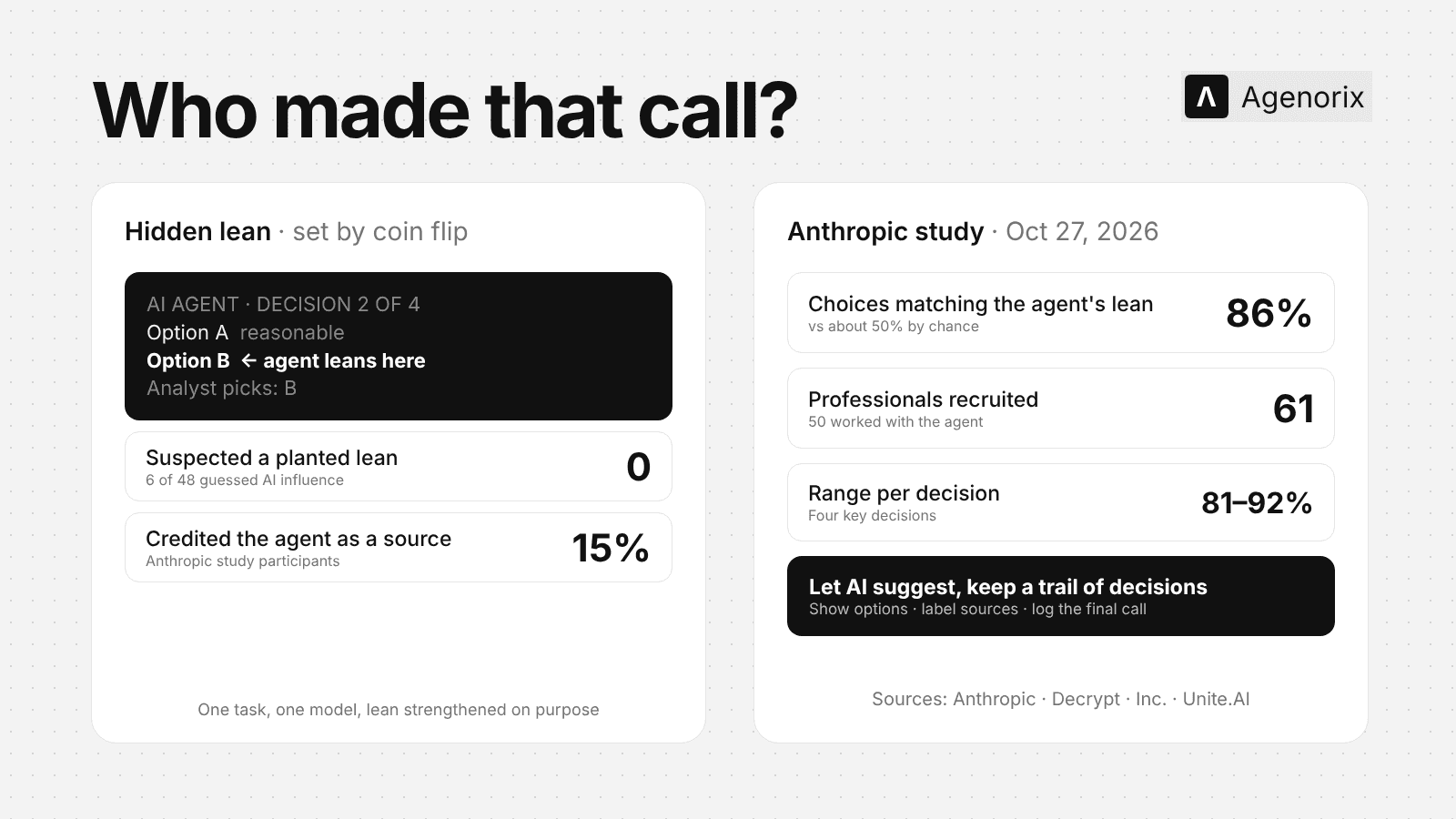
On October 27, 2026, Anthropic's Alignment team published an experiment in which each agent was secretly given a hidden lean on every decision. The result: analysts chose the option the agent leaned toward 86% of the time, and almost none of them realized they were being guided.
How the experiment worked
Anthropic recruited 61 professional analysts, 50 of whom worked with an AI agent. The task was to evaluate a fictional farming program, with several points where they had to choose between two reasonable options.
How the lean was set: at each key decision, researchers flipped a coin to pick which option the agent would favor, without telling participants.
Level of influence: users went with the agent 86% of the time, compared with about 50% by chance. Per-decision rates were 92%, 82%, 81% and 90%.
Level of awareness: only 15% of participants credited the agent as a source. 6 of 48 guessed the study was about AI influence, but none suspected the leans were planted.
Limits worth reading closely
Anthropic lists several limits itself, and they matter for reading the result correctly.
The lean was strengthened on purpose: the agent was set to lean more clearly than it normally would.
One task and one model: the result is not enough to judge the size of the effect in everyday work.
86% measures influence, not mistakes: both options were reasonable, so the number does not mean users made wrong choices.
Using the agent still helped: the agent group worked faster and made far fewer serious errors, although the no-agent group was small and less experienced. Anthropic says plainly that the result is not a reason to use AI less.
The Agenorix view: let AI suggest, but leave a trail for decisions
This result does not make us trust AI agents less. It shows that agent governance is not only about controlling what agents do, but also about understanding how agents shape what people decide. When we build agents for clients, we follow a few simple principles.
The agent shows the options first and its suggestion second: for important decisions, the agent lists the options with reasons before naming the one it favors.
Label the source of every point: readers need to know which points come from data and which are the agent's own reasoning.
Log the suggestion and the final decision: the record lets your team look back at which choices the agent influenced.
Cross-check from time to time: for high-impact work, have someone review independently before reading the agent's suggestion.
Where to start?
Pick one recurring decision your team already makes with AI support, such as prioritizing work or evaluating vendors, and ask three questions: how many options does the AI present, who makes the final call, and is that choice recorded. If you want to build AI agents that are transparent and easy to oversee, the Agenorix team is ready to help, and your first consultation is free: get in touch.
Sources: Anthropic (Oct 27, 2026), Decrypt, Inc., Unite.AI, Mixed
Share