
Google Starts Paying for Content Used in AI Search: 400+ Publications Join, Small Sites Earn Less Than 0.1% of Ad Revenue
Last week, we wrote about how Google AI Mode costs websites clicks. The natural next question is this: if AI uses your content to answer people, who pays for that content?
In October 2026, Google gave its first answer. Two programs are running side by side: News AI for news publishers, and the AI Contribution pilot, which pays websites directly inside Search Console. Both are still small and neither discloses how payments are calculated, but together they show where AI search is heading.
1. More than 400 publications join the News AI program
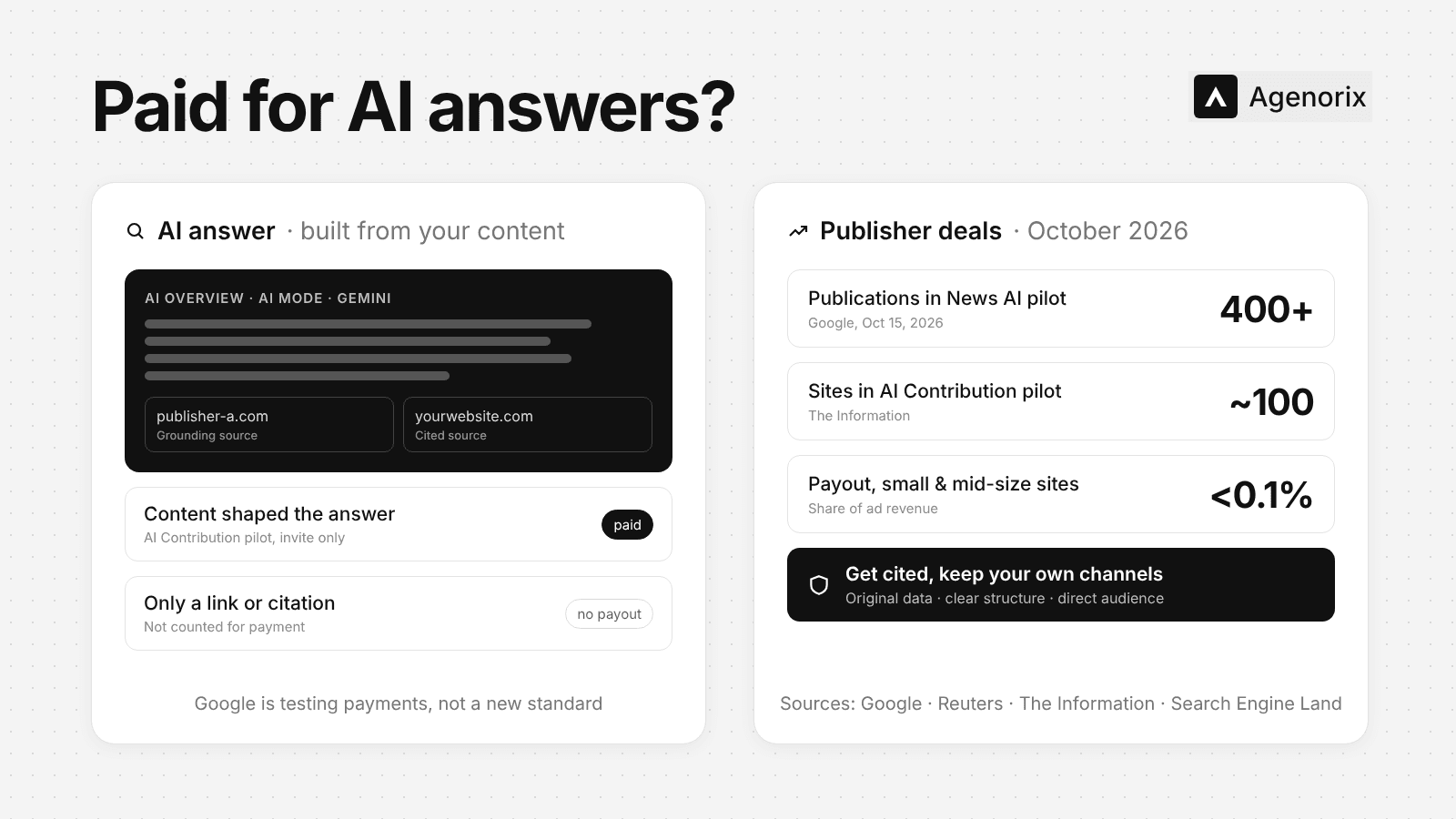
On October 15, 2026, Google said its News AI pilot now includes more than 400 publications. Google pays for enhanced content that newsrooms provide for use in its AI features.
Scale: according to Google, more than 400 publications are taking part.
Big names: according to Reuters, CNN, the Financial Times and Axios are among the latest to join.
What is unclear: financial terms were not disclosed. CNN also did not say whether its agreement includes rights to use its content for AI training.
2. AI Contribution: paying when content actually shapes the answer
The second program is closer to everyday websites. Google confirmed to Digiday on September 14, 2026 that it is an early-stage, invitation-only pilot.
Scope: it covers answers in AI Overviews, AI Mode and the Gemini app.
How it counts: payment applies when content helps generate the answer. Appearing only as a link or citation does not count.
How it works: invited sites accept program terms in Search Console, then see a monthly earnings panel and can leave at any time.
Real numbers: according to The Information (September 29, 2026), about 100 publishers are enrolled. For several small and mid-sized sites, payouts come to less than 0.1% of ad revenue, and some received under $1,000 over several months. By contrast, one early participant reportedly earns more than $1 million a year.
Little transparency: participants say they do not know how Google calculates payouts, and amounts change month to month without explanation. Google has not published any formula or figures.
3. Opting out of AI search does not protect your clicks
An understandable reaction is to block AI from using your content. A small test reported by Search Engine Land on October 29, 2026 suggests this can backfire.
Result: SEO consultant Cyrus Shepard opted his site out of Google's AI features. Click-through from AI answers had been only about 0.9%, but after opting out, regular organic clicks also fell.
Possible explanation: he called it a "halo effect": being cited by AI may make a site more trusted and more clicked in ordinary results too.
Limits: this is a small, single-site test that did not disclose traffic volume or test dates. Treat it as a signal to watch, not a conclusion.
The Agenorix view: being used by AI is a channel, not the whole strategy
For most websites, payments from Google will be negligible in the short term. What matters more is that AI search now clearly separates content that is "used to answer" from content that is merely "mentioned". When we build websites and content for clients, we follow these principles:
Have your own data: numbers, pricing, processes or hands-on experience that no one else has. This is what AI needs most and can least replace.
Write to be cited: each section answers one clear question, with a heading, figures with sources and an update date.
Do not rush to block AI: before blocking, measure what AI brings you, including indirect clicks in regular results.
Keep your own channels: email, community, social media and an AI chatbot on your own website keep a direct relationship with readers, so you do not depend entirely on the results page.
This is also how we deliver our SEO-ready website connected via MCP: clearly structured content, updated regularly and measurable.
Where to start?
Open Google Search Console, pick your 10 highest-traffic pages and search Google yourself for the main question each page answers. Note which pages are cited in AI Overviews or AI Mode and which are not, then add original data to the pages that are missing out. If you need a content plan for AI search, the Agenorix team is ready to help, and your first consultation is free: get in touch.
Sources: Google (Oct 15, 2026), Reuters, Digiday (Sep 14, 2026), The Information (Sep 29, 2026), Search Engine Roundtable (Sep 30, 2026), Search Engine Land (Oct 29, 2026).
Share