
Google Launches Gemini Agent: AI Agents Get Their Own Email, Calendar and Identity Like a Coworker
If the recent conversation has been about governing AI agents, Google has just pushed the question one step further: when an agent has an email address, a calendar and a name in the company directory, how does a business actually work alongside it?
Gemini agent: one agent for work
On October 8, 2026, at Gemini at Work 2026, Google Cloud introduced Gemini agent, described as a single agent for work. Instead of every department building its own agent, businesses hand work to one agent that operates across their apps.
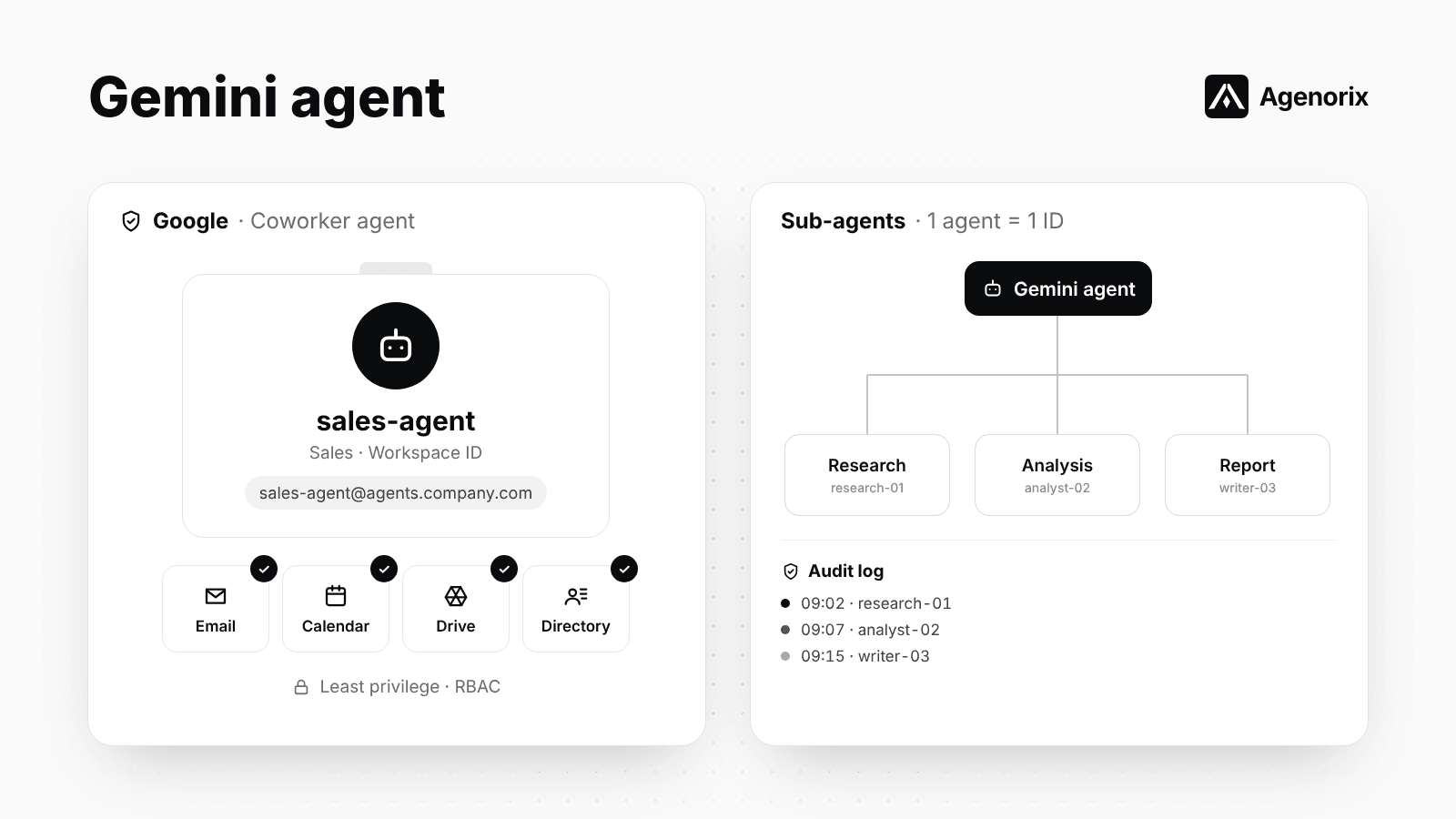
Coworker agents with their own identity: a team's persistent agent gets its own Workspace account, including email, calendar, Drive and a presence in the company directory.
Sub-agents for multi-step work: for larger tasks, Gemini agent spins up temporary sub-agents, each with its own identity, working in parallel or in sequence.
Multiple models: the agent routes each job to a suitable model, currently the Gemini family and Anthropic's Claude models.
Industry editions: in preview for financial services and legal teams, with government, healthcare and retail versions to follow.
Gemini agent is currently in private preview. Google says it will come at no additional charge for customers with Gemini Enterprise, but has not announced a firm date for broad availability.
Its own identity does not mean employee-level access
The most notable part is not that agents get email, but how Google ties identity to control:
Every agent has a verified identity and role-based permissions.
Audit logs name the agent, rather than folding its actions into the person who assigned the task.
Coworker agents only see what team members choose to share, instead of inheriting broad organizational access.
In other words, having its own email address does not give an agent the same rights as an employee. That is exactly the direction businesses need: agents that are traceable, clearly bounded and owned by someone accountable.
The Agenorix view: design an agent like you design a role
As AI agents become digital coworkers, the most effective way to deploy them is to treat each one like a position in your organization. For every agent we put into operation, we answer four questions before writing the first line of code:
Job description: what the agent does, and what it does not do.
Direct manager: who assigns its work, who reviews the results, and who is accountable when it gets something wrong.
Access: which data and systems it can reach, and for how long.
Performance review: measured with concrete business metrics such as turnaround time, error rate or cost per task.
An agent with its own identity makes these questions easier to answer, because every action is tied to a specific "someone" in your systems.
What should businesses do now?
You don't need to wait for Gemini agent to roll out broadly. Pick one repetitive, multi-step process, such as compiling weekly reports, handling internal requests or preparing customer files, and write a "job description" for an agent using the four questions above. That groundwork carries over to any platform. If you'd like a partner along the way, the Agenorix team is ready to help, and your first consultation is free: get in touch.
Sources: Google Cloud Blog ("Gemini at Work 2026", Oct 8, 2026), TechCrunch (Oct 8, 2026), VentureBeat, 9to5Google, Futurum Group.
Share