
OpenAI Says ChatGPT Has Reached About One-Fifth of Google's Search Volume: People Aren't Leaving Google, They're Searching in More Places
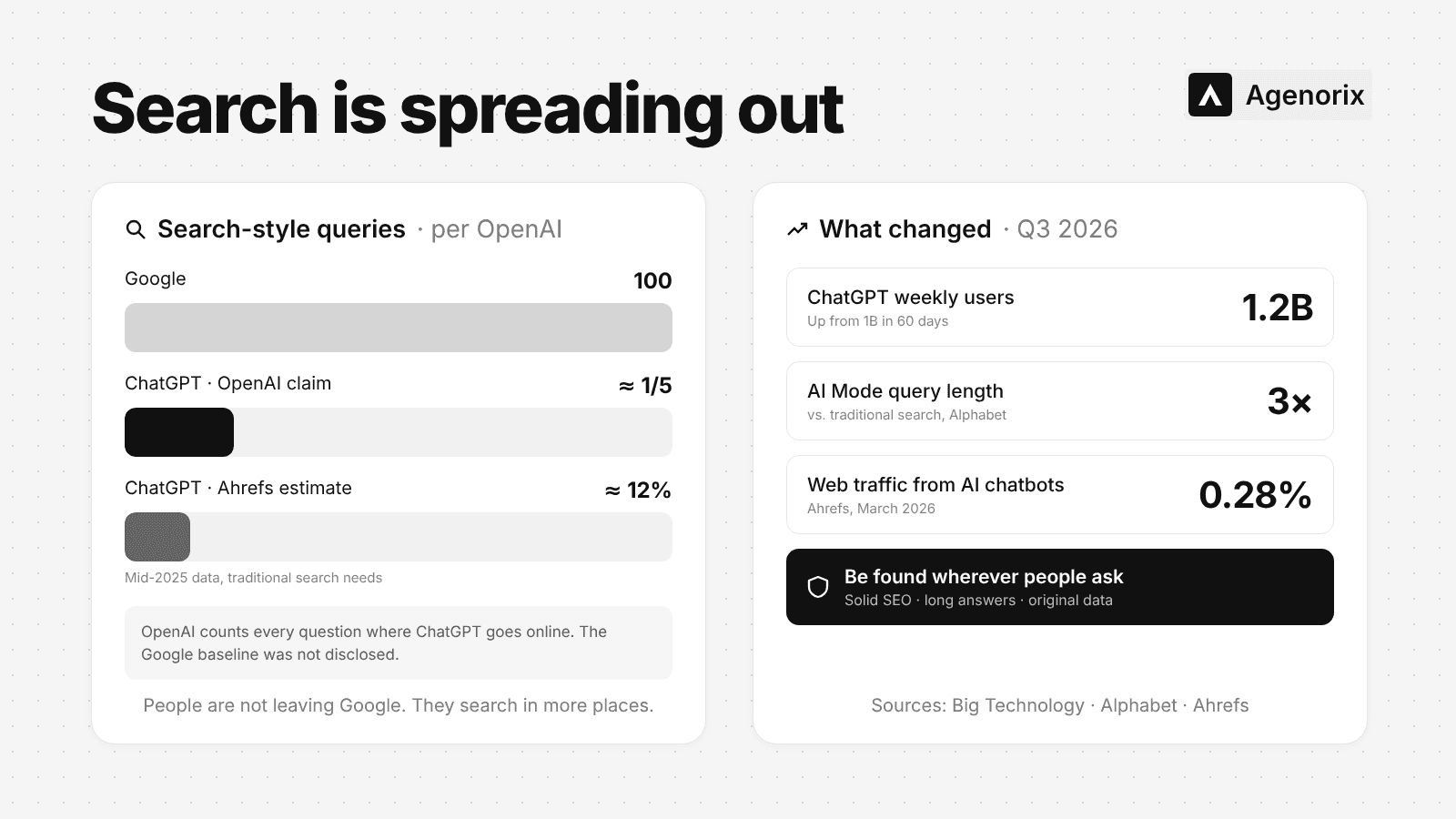
In our article on Google AI Mode costing websites clicks, we looked at AI answering questions right on the results page. This week the story moves beyond Google: on November 2, 2026, OpenAI said the volume of search-style queries on ChatGPT has reached about one-fifth of Google's.
That number sounds big, but it needs a careful read. At the same time, Google reported its fastest search query growth in five years, and the traffic AI chatbots send to websites is still a very small share. People are not leaving Google. They are searching in more places.
OpenAI says ChatGPT is about one-fifth of Google
The claim came from Adam Fry, OpenAI's consumer product lead, in an interview with Big Technology. It is a statement made in an interview, not a published dataset.
How it is counted: OpenAI only counts questions that make ChatGPT go online to look things up. One long conversation can produce several of these searches.
Not verified: OpenAI did not share ChatGPT's actual query count or say where the Google figure used for comparison came from. "About one-fifth" also does not mean exactly 20%.
Independent estimates are lower: using mid-2025 data, Ahrefs estimated ChatGPT at only about 12% of Google's search volume for the kinds of needs people have traditionally searched on Google.
User base: according to Fry, ChatGPT grew from 1 billion to 1.2 billion weekly users in just 60 days, and its voice features have around 250 million weekly users.
Google is still growing, but search is changing shape
Alphabet's Q3 2026 results, published on October 28, show Google is not losing users. What is changing is how people ask.
Fastest query growth in 5 years: according to Alphabet, year-over-year search query growth is the highest in five years. Search revenue grew 12% to $63.3 billion.
Longer questions: AI Mode queries are on average 3 times longer than traditional searches, and 1 in 5 AI Mode searches uses voice, images or documents.
Ads follow AI: Google said AI Mode is growing fast but earns less than traditional search, and it is expanding ads in both AI Overviews and AI Mode.
Traffic from chatbots is still small and unpredictable
Even though ChatGPT gets asked a lot, most answers do not send readers to a website. The figures below come from different analytics companies measuring in different ways, so treat them as directional.
A very small share: according to Ahrefs, in March 2026 AI chatbots sent around 3.5 million visits to the 74,752 websites it tracks, equal to 0.28% of total traffic.
ChatGPT dominates: studies by Previsible and BrightEdge show ChatGPT accounts for more than 90% of traffic from standalone AI chatbots.
Up and down: a change in how ChatGPT links to sites in May 2026 made traffic jump within a week, while LLM Pulse recorded a drop of around 46% between October 9 and 11, 2026 across the websites it monitors.
The Agenorix view: optimize to be found wherever people ask
Counting Google, AI Mode and ChatGPT together, people are asking more questions than ever. The catch is that answers increasingly appear before anyone visits a website. When we build websites and content, we treat traditional SEO and being cited by AI as one job, with four principles:
Technical SEO is still the foundation: fast pages, clear structure and complete structured data. Google is still the largest source of traffic, and AI tools also rely on well-indexed content.
Write for longer questions: when queries are 3 times longer, each page should fully answer one specific need, with data, examples and a short answer at the top of each section.
Give AI a reason to cite you: original data, real-world experience and up-to-date information are hard for AI to synthesize on its own, so they are more likely to be credited.
Measure each source separately: separate traffic from ChatGPT, Gemini and Perplexity from regular search in your analytics, and track it monthly rather than daily because the numbers are still volatile.
Where to start?
Pick the 5 questions your customers ask you most often, then put each one into Google, AI Mode and ChatGPT. Note whether your website appears or is cited, and which competitors are answering in your place. This small comparison shows you which pages to rewrite first. If you would like to work through this step together, the Agenorix team is ready to help, and your first consultation is free: get in touch.
Sources: Big Technology (Nov 2, 2026), The Verge, Search Engine Roundtable (Nov 3, 2026), Alphabet (Oct 28, 2026), Ahrefs, Previsible, BrightEdge, LLM Pulse
Share